Tuesday, September 27, 2011

Commercial Structure Fire

I was sitting in the recliner watching some college ball waiting for my family to arrive. They were going to visit the station again. The kids love to visit and race around the fire house. I think our massive balcony is their favorite part. I check my watch and thought that they should be getting there any minute, which meant we should be getting a call. Sure enough, the structure fire tones sounded.

Photo by Nika Megino

I jumped up and ran over to the fire pole. It took me about a second to slide down the 25 foot drop to the ground floor, much faster than taking the stairs. We all quickly donned our turnout gear and jumped into the truck. I assumed that this was going to be just another false alarm and that we would be back at the station in a few minutes. Those thoughts vanished as dispatch gave us more information.

Engine 50, engine 52, engine 54, truck 51, Truck 110, engine 82, Rescue 54, battalion 11, battalion 13, commercial structure fire. We have multiple callers reporting smoke and flames showing.

That's me at the tip of the ladder. Photo by Nika Megino.

As we turned right out of the station we looked toward the address and immediately saw the dark plume of smoke. On the tactical channel my captain gave an update, "All units responding be advised truck 51 has smoke showing from the station."

We knew going into this fire that we would be going defensive right away. The building is an old abandoned Circuit City. Over 20,000 square feet that had been empty for years. In fact, we had used this building for training. We knew that the roof had dozens of holes cut by us. Also we had already had several fires (usually started by squatters) in this building. Enough so that the structural integrity of the building, especially the roof, was in question.

Engine '50' with two 2 1/2" lines going interior.

The first in engine arrived on scene and sized up the situation. There was heavy smoke and flames on the Bravo/Charley corner (For firefighters to better be able to describe a building the front is the Alpha side. You then move clockwise around the building so that the left side is the Bravo side, the rear is the Charley side and the right side is the Delta side). They also called for a second alarm giving us two more engines, a truck and another BC. It never hurts to have more manpower.

As we were pulling up Engine 50 announced that the hydrant on the corner that they had tagged was dry. Engine 52 stopped at another hydrant and started laying their LDH so that we would have a water supply. Another engine was direct to the hydrant over the wall from Engine 50. The crew from 50 laddered the wall and handed over their 5" supply line.

My view of fire attack.

While the engines worried about their water supplies and hoses we position the truck as close as we could to the burning section of the building. This was difficult because of mounds of dirt and debris all over the old parking lot. We then extended the stabilizers and raised the ladder. Our truck has a pre-plumbed water way so we didn't need to connect any hoses before getting into place. Once the ladder was up I climbed to the top. We then started flowing over 1000 gallons of water a minute onto the fire.

All the crews on the ground (looking to me like ants) were told to not go into the rear of the building while I was flowing water. I was putting more than 4 tons of the wet stuff into the building and onto the roof every minute. We didn't want anyone near that!
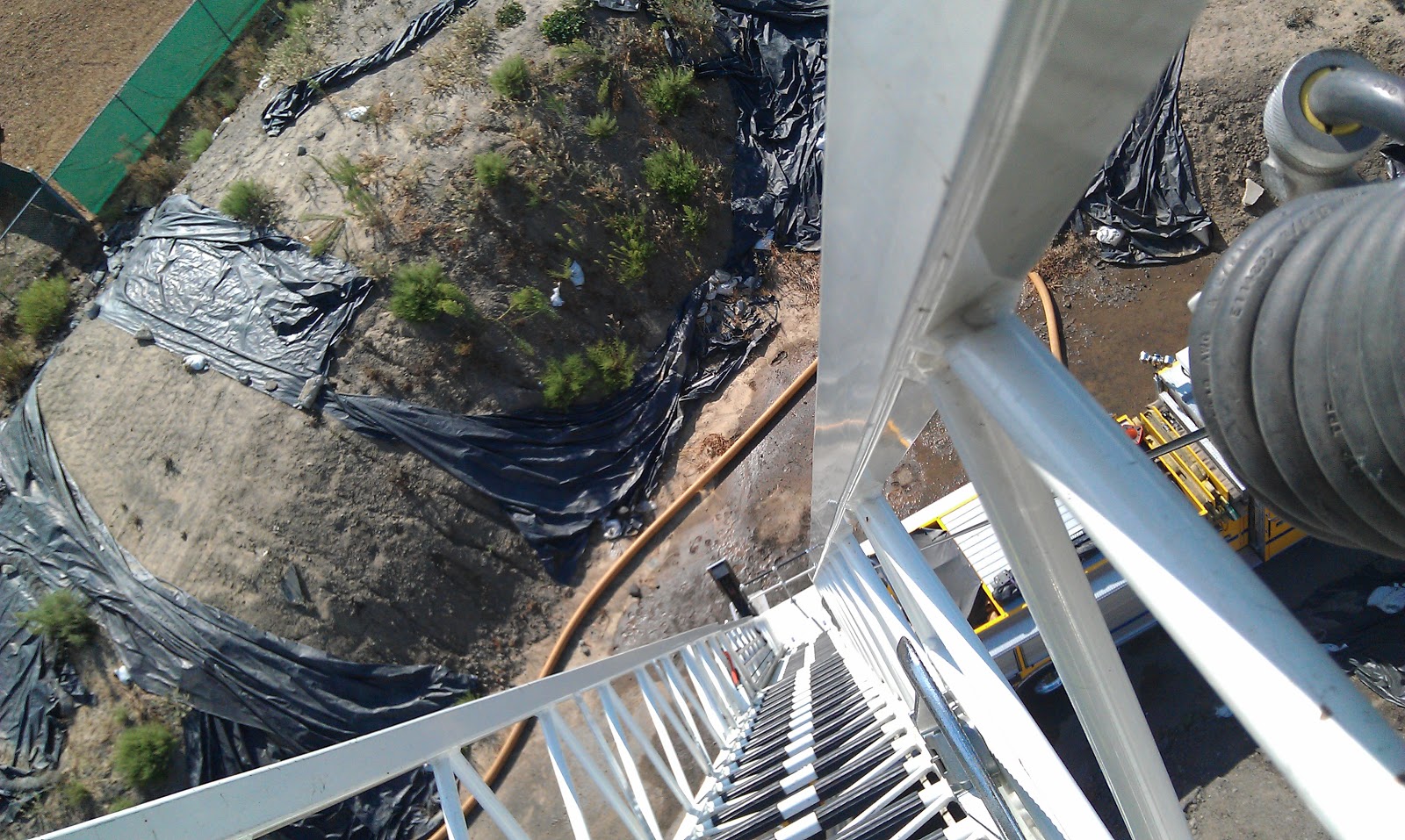
Anyone want to join me?

One of the crews got a report that a homeless man may have still been inside. They immediately started a search from the front. Once they were in position, with a hose line, we shut down the water tower. I then spent the rest of the operation as the eye in the sky. I was able to direct crews to hot spots and to give the IC information on the progress. I had a very unique view.

After interior efforts were stopped we again turned on the big guns. We soaked everything we could. Engine 50 also helped out with their deck gun because it's set up with the ability to use foam. By the time that we left there was over a foot of foam and water all over the roof and the interior.

The roof after the fire.

We then had to pick up the hundreds of feet of hose of varying sizes and reload them. Back at the station we washed the truck down. Four hours after the tones went off I was in the shower cleaning up.

My view of the supply lines.

And the homeless man that was reportedly inside? He was found eating a hotdog at the gas station watching everything go down.

Wednesday, September 21, 2011

Shutting Us Up

Someone did something that caused three firefighters to be speechless. That's quite a feet.


We got a call for a citizen assist the other night. Usually this means that someone fell down and the family members are unable to get them back into their chair or bed. Imagine our surprise when we were informed that we were going to help someone that didn't know how to clean up the broken wine bottle and spilled wine from under their car in the garage.

I'll wait a second while you re-read that and shake your head. Yes, you read it right.

When we arrived we were met by a woman in her late 30's. She appeared to be a well dressed business woman, and judging by the BMW in the garage, a successful one. She started by saying she only called 911 to get some advice. You see, she was afraid of the flammability of the alcohol in the wine. She said she, "didn't want to blow up in the morning."

We assured her that the small amount of alcohol would not ignite even if she were to start her car now and that by morning the alcohol would all have been evaporated.

After the call, we drove back to the station in almost total silence. The only thing said was, "I don't know what to say."

On a more positive note her 13 year old daughter squealed in delight and told anybody listening that that was the closest she'd ever been to a firefighter. We showed her the truck too. I think we made her night.

Tuesday, September 20, 2011

Oh! The Irony

So while I was at work I received a negative comment on my post 50mg Of Benadryl And Some Morphine. So I took the time to respond with a blog post instead of a lengthy comment (and I decided that getting negative comments is kinda fun). My original post was about a "frequent flyer" that just wants narcotics. She's well known to every firefighter in the area.


Fast forward about an hour after we went to bed. The tones went off and the dispatcher rattled off a familiar address. As we approach we notice that the front door is open and our favorite patient is waiting for us. She's learned not to ask for Morphine directly. This time she said that the medics before had given her a shot of Benadryl for her anxiety and another shot. She danced around the subject of MS for quite a while. In the mean time we grabbed a set of vitals (which we all well within the normal range).  She wasn't showing any of the signs of being in pain.

She then spent the next few minutes complaining about nausea. She explained that she had been vomiting all day. And that because of the vomiting she was experiencing abdominal pain. That, according to her, was the reason she needed the 'other shot.' Instead, we attacked the root of the problem. We gave her something for the nausea. She wasn't too happy that we weren't playing the game by her rules.

When AMR arrived I gave them a quick rundown on the patient. We then helped her onto the gurney and loaded her up. What was the last thing I heard her asking for as I shut the back door of the ambulance? You guessed it, a shot of Morphine.

Monday, September 19, 2011

Hate Mail

I feel like I've hit a mile stone with my blog. My first hate mail, er, comment anyways. And when I tried to answer it and explain my position a little better, I got another one. So instead of trying to explain things in the comment section I decided to do a post about it.


The original post, 50mg of Benadryl And Some Morphine, was about a drug seeker and my refusal to give them Morphine. In it, I mentioned that we have to ask a patient to rate their pain on a 1-10 scale. I think this is a waste of time because there's no real way for a health care professional to know what the patient's worst pain is. If your worst pain is a stubbed toe than a sprained finger is a   10. If you have had cholecystitis, then a sprained finger is a 2. So if the number rating is arbitrary then I have to go by my assessment to determine how much pan management is needed. 


Evidently Mr. (assumed from the typos and un-lady like language at the end of the first comment) Anonymous didn't like this. He said, 


""We always ask the patient to rate the pain. I generally don't care what they say their pain level is, their body language always tells me what I need to know. So why do we ask? I digress."

how woudl ur boss feel if they saw that? cunt
"


I tried to understand where they were coming from. I reread my post and tried to explain where I was coming from. I replied, 


"My Chief is a medic as well and I think he would back me up 100%. I think you may have misunderstood what I was saying. I don't care what number they assign to their pain. My 4 may be your 10. The number is a waste of time but is used for paperwork. I treat my patient instead."


He really didn't like that. Mr. Anonymous commented,


"You have a God complex. It's not up to you to "decide" what a person's pain level is. "My 4 may be your 10". You're not the one in pain so you have no clue how bad their level is. You're what's wrong with the medical field nowadays-you don't listen to the patients and make assumptions based on how YOU judge a persons body language."


So I am going to make a couple of assumptions based on these comments. First, I think Mr. Anonymous has had a bad experience with someone in the medical field that did not his pain or pain management seriously. Having been in severe pain I can imagine the anger of someone that wasn't properly treated for pain. Second, I don't think that Mr. Anonymous is in the health care field. More specifically, in the pre-hospital setting. If I'm wrong, I'm sure he'll let me know.


Mr Anonymous, you obviously think that I'm in the wrong, at least as far as patient care is concerned. Let me explain my approach to pain management. If, through a thorough assessment and examining the signs and symptoms of my patient, I determine that they are in pain, I do everything in my power to relieve that pain.


In a perfect world all I would have to do is trust a person when they say the hurt. Unfortunately, we don't live in a perfect world. I have to deal with people that lie. One of the more common misrepresentations is that of being in pain. People addicted to narcotics have been known to call 911 with the intent of getting morphine. If we as medical professionals were to just give out MS to every patient regardless of our own assessment we would not only possibly be causing more harm to our patient by feeding their addiction but we would then have every addict in the country calling 911 to get their fix. So to keep from doling out medication unnecessarily we have to judge for ourselves how much "pain" a patient appears to be in.  

How do we check someone's pain level? There are actual, physiological changes to the body when someone is in pain. There's a great paper (do you still call it a paper if it's online?) on the subject on the NursingTimes website. I'll provide a quick overview but you can find better detail in the article.


We'll start with the patient's heart rate, it goes up. As does their respiratory rate and blood pressure. There can be impaired thinking if the pain is severe enough. Oxygen saturation may be low. Nausea and vomiting often accompany intense pain. Because of the sympathetic response the patient may appear pale and sweaty. There are many other things going on with the body as it reacts to pain but those are the most obvious and easiest to assess.


So Mr. Anonymous, when I'm dealing with a 30 year old patient, with a known history of seeking narcotics, what would you have me do? Should I listen to them as they calmly tell me that they are in the worst pain of their life? Should I immediately dive for my morphine and draw it up stat? Or should I look at her vitals and perform an assessment? If her heart rate is 62, she's breathing 12 times a minute with a pulse oxygenation of 100%, their skin tone is normal in coloration, temperature and moisture, no nausea or vomiting, and their BP is normal should I ignore all the clinical data that says the patient is probably not in severe pain? I think not. 


Somehow I get the feeling that you, Mr. Anonymous, are still going to say that I need to listen to my patient. So is that true in every case? When a woman is having a heart attack but she denies it should I just trust her? No. That's why I went through schooling to become a medical professional. Contrary to what you may think we medical professionals have to do more than just listen to you. We have to look at clinical data as well. I'm sure there are some people out there in the medical field that have taken things too far the other way and they rely solely on the signs that they can observe, never listening to their patient. I am not one of those people.


Have no fear, if I respond to your home and you or a loved one are in pain, I will treat you appropriately. 

Saturday, September 17, 2011

Stop Being An....

The lights clicked on in my room for the third time that night, and it was only 0230. They were immediately followed by the familiar tones of a medical aid. We grumble and stumble out to the rig and slide into our bunker gear.


While watching the houses go by the rig as the were being pummeled by red lights dispatch said that we were responding for a fall victim. Pulling up on scene I recognized the house. We had been there before, often.

My citizen in distress was a 70 year old woman. She's obese. Shocker huh? She has had a heart attack in the past and now has CHF. She also smokes more than a structure fire. Enough that I always feel the need for a shower when I'm done with the call so that I can get the smell off of me. She has COPD, Emphysema and Asthma. She's supposed to be on home oxygen but every time we're there the cannula is tucked into the corner, unmoved, I'm sure, from the last time we were there. And she also wonders why she gets short of breath when she does the simplest of tasks. And to top everything off, she has an attitude.

We walk up to the door and find her husband waiting. She is sitting on the floor in between her recliner (the kind that stand up to help people get out) and her wheel chair. We ask if she is injured and she says no, just stuck. We help her back up into her chair. Usually this is all we do. This time they needed more help.

We then helped to move her to her portable commode. While she did her business we stepped outside. She took the opportunity to light up another cigarette. We then helped move her back into her wheelchair and then moved her once again into her recliner.

Now I don't mind "citizen assist" calls. I really don't. I don't mind helping people do things at their house that might prevent us from going back there in a few hours. I can even stand ending up smelling like stale cigarettes to help someone.

What pisses me off is when someone that needs my help, because they won't take proper care of themselves, has an attitude about it. Maybe, just maybe, you should try being nice to the people that are just there to help you.