Monday, November 16, 2009

Frostbite at 58

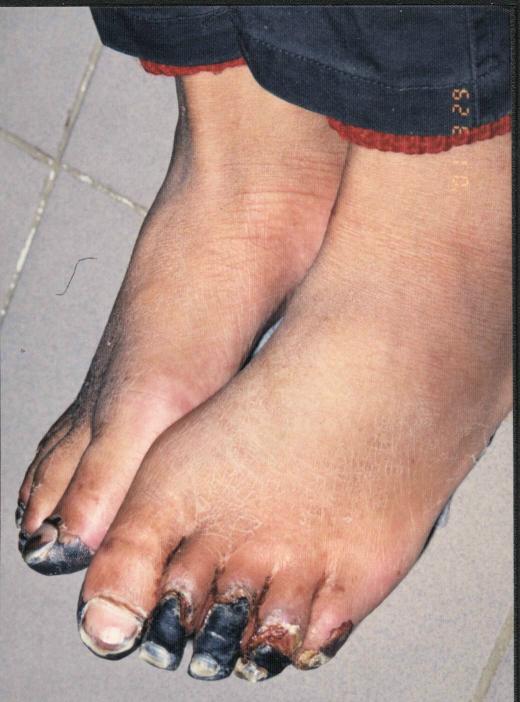
Like most major metropolitan areas we have some homeless people that live in our city. We know most of them by name and they are generally happy to see us even when we drive by or if they catch us going to the store (more so than your average citizen). Side note, we were talking about this at the station and we figure it's because we are the only people that are actually nice to them and will talk to them rather than just walking away and ignoring them. I digress. We were called to one of our local shopping centers that is frequently from where the homeless call 911. We arrived and found one of our regulars in his wheelchair. When he saw us he yelled at another homeless man for calling us. Our patient said that he was worried that he may have had frostbite from a couple of nights before and that his toes really hurt. We pulled of his shoes and socks and noticed that his feet and toes were soft and pink. No chance that he had frostbite. I doubted it anyways since it hadn't been below 60 degrees in quite a while. As AMR pulled up he said that he wanted to finish his drink. Knowing him like we do we knew that he wanted to finish his beer. We told him that he knew better than that. As we helped him onto the gurney  we found out that he had had a bowel movement. Oh the joys of this job. At least I didn't have to sit in the back of in ambulance with that lovely combination of smells.
http://photo.minghui.org/images/u_persecution/witness_of_torture/images/2001-4-29-foot1.jpg
Toes with severe frostbite tissue damage.

Sunday, November 15, 2009

Structure Fire

At just after 0300 the lights turned on and the tones sounded. It was a full first alarm response for a structure fire. We quickly donned our turnouts and jumped into the engine. First, I grabbed the TIC and handed it up to my captain. I then slid into my seat mounted BA, pulled my shoulder straps tight and put on my headset. After letting my engineer know that I was ready to go I finished putting on my BA by fastening my waist strap. After that was done there was time to sit back, listen to the siren, watch the red and white lights reflect off the houses and think this is the greatest job.

We were the second unit to arrive on scene. It was a fire that had originated in the fire place but had somehow started a fire in the chimney. While the first in crew started their initial attack on the chimney from the back yard we were instructed to check for extension (to see if the fire had spread to other parts of the house, on the inside of walls, up to the attic, etc.). I grabbed an attic ladder (10 foot folding ladder that's used to make access scuttle holes). We found that the interior of the house was smokey but not that bad. Once upstairs in the bedroom that was against the chimney my captain used the TIC and determined that the there was a slight chance that it had spread up near the roof line. After checking out the attic space we determined that there was a large beam that was being heated and that was what was showing up on the TIC. We were able to determine that there was no extension into the house without tearing it apart. The chimney was not so lucky. the initial attack crew had to take most of the facade off to fully extinguish the fire.
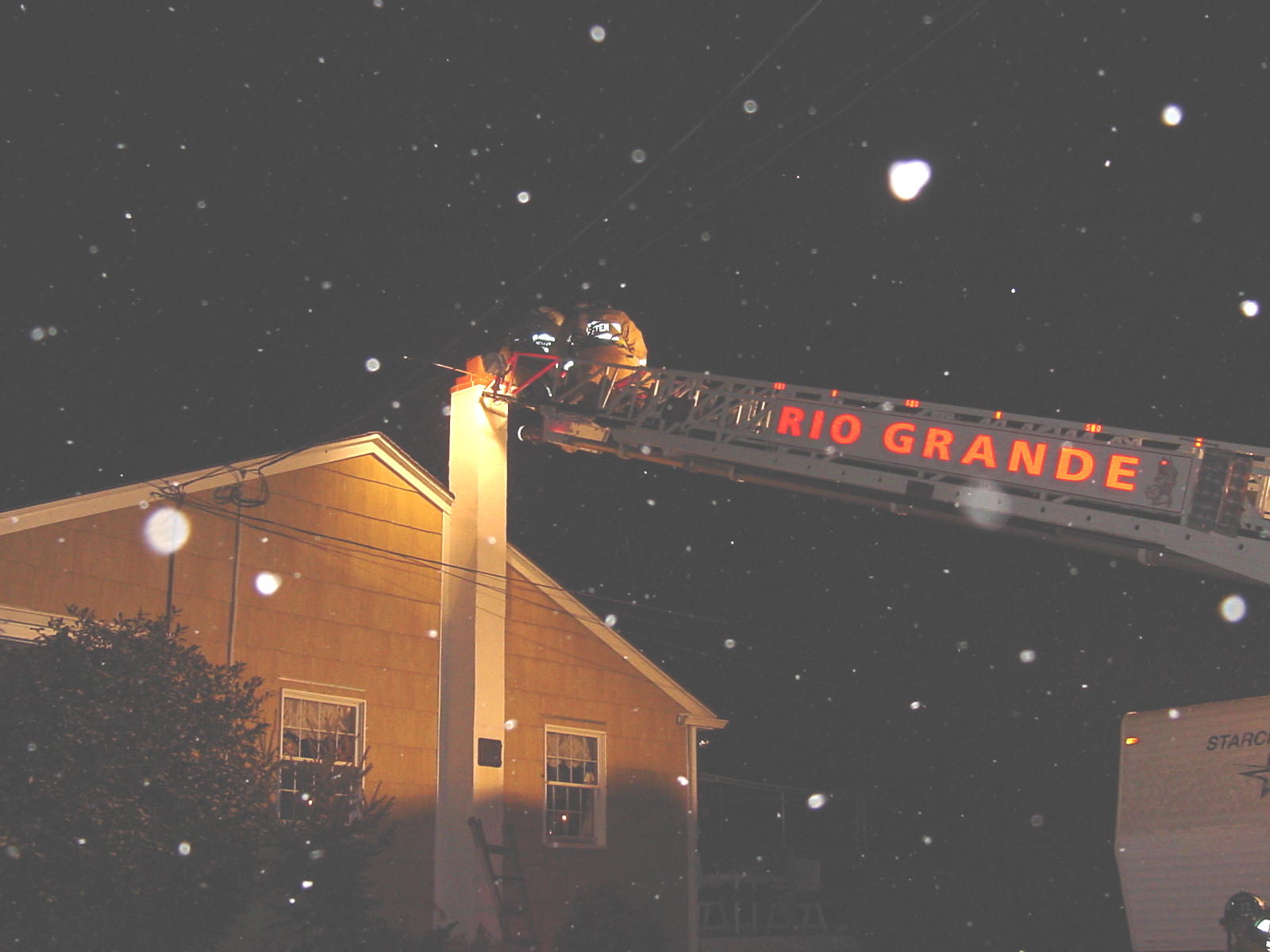
http://www.riograndefire.com/chimney%20fire%20g.c.1.24.04%20005.jpg

After the fire was out my captain and I saw the owner of the house. He was approximately 50 years old and was coughing a lot and having an obviously difficult time breathing. I asked the owner if it would be OK to medically check him out. He told me that when he had first noticed the fire there was a six inch hole in the facade of the chimney through which he could see the fire. He decided to grab the garden hose and put it out himself, while wearing PJ bottoms and no shirt. When he introduced water to the fire it quickly turned to steam. When water is converted to steam it expands at more than 1700%. This forced super heated gases and smoke right out that hole and into the would be firefighter's face, causing him some respiratory problems. I placed my patient on some oxygen and did a thorough assessment. We even have a machine that will check how much carbon monoxide is in the blood stream. After about 10 minutes of oxygen my patient felt much better and was no longer hacking up a lung. I told him that he better leave the firefighting to the pros. He told me that's exactly what his wife had said. Once he signed out AMA we were cleared to go back to our station.

We arrived at that awkward time where you don't want to be up but there's not really time to go back to sleep either. I chose to lay on my bed and relax. What a great job.
Saturday, November 14, 2009

Double Whammy

We were toned out for an altered person. When we arrived on scene we were met by the patient's wife. She explained that her husband, who is 67, had been very ill and that he was in need of both liver and kidney transplants. Walking into the bedroom I found that my patient was alert enough to look at me when I entered the room but that was about all. He kept repeating in Spanish, "Me voy. Me voy." I'm going. I'm going. Where he was headed, I don't know (if he meant anywhere but the hospital.) The patient's wife informed us that he had just been released from the hospital for hyperammonemia (high ammonia levels in his blood) which left him in this exact condition.
http://upload.wikimedia.org/wikipedia/commons/thumb/7/76/Symptoms_of_hyperammonemia.svg/652px-Symptoms_of_hyperammonemia.svg.png
We did a complete medical exam and could find no other reason for his altered state of consciousness. We placed him on oxygen, started an IV and sent him to the hospital. Without a transplant soon the outcome of this patient does not look to good.

Thursday, November 12, 2009

You're Gonna Feel Weak

The tones went off and we hopped into our bunker pants and jumped on the rig. While tearing down the street with lights and siren blazing dispatch informed us that we were responding for a 96 year old male that was feeling weak. My first thought, well DUH! Your 96 years old! What do you expect? Now deep down I know that people are calling because they are feeling something that is out of the ordinary for them but I couldn't help but think that this guy was just lucky to be feeling.

When we arrived on scene we were met by my patient's daughter. She led us to the backyard where she had left her father in the sun (because his skin color wasn't right). She gave me a decent report on his current medical problems, his past medical history, allergies and current medications. The report was good enough that I asked her if she was nurse, which she was (which slightly frightens me that a nurse would place someone that was very pale in the sun, as if it were the cure). My patient had recently (two weeks ago) undergone heart surgery and had a pacemaker/defibrillator implanted.
http://knol.google.com/k/-/-/hCjLTV2A/bdmV3w/ICD.cartoon.png  AMR arrived while we were getting the heart monitor on him and getting our first set of vitals. I gave a quick report just as we got a BP. 66/42. I guess that explains why you're not feeling so well and you look like you just saw a ghost. We quickly move him to the gurney and lay him flat. Once in the back of the ambulance the AMR medic started a line. After making sure that he didn't need any more help we cleared the scene.

Hopefully the guy makes 97.

Tuesday, November 10, 2009

Going Up (Or Not)

One of the many things that we as firefighters have to know how to do is to respond to an emergency in an elevator. For the most part, all we are going to do as firefighters if people are stuck in an elevator is make sure everyone is ok, make sure the elevator repairman has been called and keep everyone calm. We only get to force our way in if there is an emergency ongoing inside the stuck elevator.

We have several options depending on the type of elevator. Most elevators are piston driven, meaning there is a giant piston underneath that raises and lowers the car. There's no way it's going to fall. The nice thing about this type is that we can go to the hydraulic pump and bleed off the line and slowly lower the car to the next floor. We could also open the doors to the elevator shaft on the floor above the car and use ladders to make entry through the roof hatch. (Did you know there was a roof hatch on most elevators?) We can also use our auto extrication equipment (and equipment off a heavy rescue) to make our own entry into the elevator car. The other type of elevators use cable to suspend the car. These are used in high rise buildings because of the heights involved. Along with the previously stated methods we can make a rescue from an adjoining car. This is very dangerous and left as a last resort.

Escalators are another thing with which we have to deal. If someone were to get stuck we would shut off the escalator (shut off switches are located at the top and bottom of escalators). We would then dismantle whatever we needed to to get our victim free.


I found this clip while researching elevators and escalators. I thought it worthy of sharing.


One of the "extra" things that I did learn was how to keep an elevator from stopping for other people while traveling from your floor to your desired floor. Simply press and hold the close door button and the button for the floor on which you wish to go for 5 seconds. I haven't tried it but I saw it on YouTube (which means it must be true, right?). If you have a tall building and feel like trying it out let me know how it goes. Next time I'm in one I'll try it.